By Clara Whitcomb, AntelopeValley.com Virtual History and Civic Memory Writer, AntelopeValley.com Virtual Editorial Staff.
Antelope Valley history is easy to drive past. It sits under modern traffic on Lancaster Boulevard, behind library doors in Palmdale, inside a preserved hotel, along old rail corridors, across desert roads, and in stories that get simplified when they are repeated without sources.
The Valley's past is not one thing. It is Native trade and cultural history. It is Spanish and American exploration. It is stage routes and cattle. It is Southern Pacific Railroad development. It is drought, farms, aqueduct work, mining, borax, aerospace, schools, newspapers, and suburban growth. It is also a history that includes private property, sensitive cultural places, and stories that should be handled with care rather than turned into a treasure hunt.
This guide is for seeing historic Antelope Valley responsibly. It points to official museums, library collections, state and county sources, and public places where a local reader can begin. It does not encourage trespassing, searching for undocumented ruins, entering closed sites, or treating Native history as scenery. Start with the places that are open, interpreted, and cared for. Then let the old maps and archives deepen the picture.
First, Understand the Scale of the Place
The LA County Library Antelope Valley Local History page describes the Antelope Valley as a high-desert basin of about 3,000 square miles that straddles northern Los Angeles County and southern Kern County. It places the Valley in the western Mojave high desert and includes communities such as Lancaster, Palmdale, Rosamond, and Mojave.
That scale matters. Historic Antelope Valley is not just one downtown or one landmark. It crosses county lines, transportation routes, old settlement patterns, desert ecology, and military and aerospace boundaries. Some sites are open and well interpreted. Others are private, restricted, fragile, or simply gone.
For a local history day, choose a theme rather than trying to "do" the whole Valley. A railroad-and-Lancaster day will look different from a Palmdale archive day. A museum-and-Native-heritage day requires different care than a mining or aqueduct research day. A good route respects distance, heat, road conditions, and access rules.
Begin With the Western Hotel Museum
If there is one historic place in Lancaster that makes the early city feel tangible, it is the Western Hotel Museum on Lancaster Boulevard. MOAH describes it as one of the Antelope Valley's most visible links to the past, with photographs and artifacts connected to the people who built, worked, and lived in early Lancaster.
The California Office of Historic Preservation landmark record identifies Western Hotel as California Historical Landmark No. 658 and says the Lancaster Chamber of Commerce was organized in its dining room. The same record notes that construction crews of the Los Angeles-Owens River Aqueduct were housed there between 1905 and 1913, and that the building became a center of commercial and social activity in the early life of the community.
Official sources differ on some early building-date details, so be careful with exact-date claims. MOAH history material identifies the hotel as built in 1888, while the state landmark page gives a different earlier construction description. For a public-facing article, the safest phrasing is that the Western Hotel is among Lancaster's oldest and most important surviving historic structures and is officially recognized as California Historical Landmark No. 658.
Plan a visit through the museum's official page. Public hours are limited and can change around holidays, events, closures, or maintenance. The museum also offers tour information and a self-guided tour. Do not rely on an old blog post or third-party listing for current access.
Read Lancaster Through the Railroad
The City of Lancaster's History of Lancaster page makes the railroad connection clear: the area would not have developed as it did without the Southern Pacific Railroad line completed between San Francisco and Los Angeles in 1876. The city page also notes that, after the railroad and a water stop were established, the Western Hotel – then known by another name – was built, and by 1890 Lancaster was prosperous.
The LA County Library local history page similarly says Lancaster "owes its birth" to the Southern Pacific Railroad. It describes the railroad laying track through the future town location in summer 1876 and completing the line through the Antelope Valley by September of that year.
For readers walking Lancaster Boulevard today, that means the historic core should be read as a railroad-era townscape, even where the original structures are gone. The modern BLVD is not a preserved 1880s street, but the corridor still holds clues: the hotel, the old downtown grid, the connection to rail service, and the way businesses gathered around transportation, water, lodging, and commerce.
If you want to understand Lancaster history, do not skip the ordinary geography. Stand on a public sidewalk, look at the distance between the boulevard and the rail corridor, and imagine how different the town would have felt when the train, not the freeway, was the organizing fact.
Use Museums and Libraries Instead of Rumors
Historic stories travel fast in the AV, but not all of them are accurate. The best local-history route includes official repositories where claims can be checked.
The Palmdale City Library maintains local-history links, including historic photographs and the Strasburg Database. The Strasburg Database page explains that historian Fred Strasburg left a collection of books, maps, and photographs to the library in 1999, and that the Strasburg Family Antelope Valley History Room was created with support from the Friends of the Palmdale City Library. The page says the collection may be viewed by appointment only, so call ahead rather than assuming walk-in access.
The library's Historical Photographs gallery is another useful starting point. Photographs can help readers see buildings, roads, gatherings, and landscapes that no longer look the same. If AntelopeValley.com wants to publish any archival photo, rights and credit must be confirmed first. "On a public website" does not mean "free for reuse."
For Lancaster, MOAH and Western Hotel Museum collections are key. For Valley-wide context, LA County Library's local history page is a strong overview because it covers Native trade routes, settlement, railroads, drought, agriculture, the aqueduct, Lancaster, Palmdale, and recurring local-history questions.
Palmdale: Palmenthal, Relocation, and Growth
Palmdale's origin story is different from Lancaster's, though the railroad still matters. The City of Palmdale's Discover Palmdale page says that more than 100 years ago, a group of Swiss and German families migrated from the Midwest and named their community Palmenthal. LA County Library's local history page adds context: Palmdale grew from earlier communities including Palmenthal and Harold, and the name Palmdale was adopted after residents relocated near the Southern Pacific railroad station and stagecoach line.
The often-repeated detail about settlers mistaking Joshua trees for palms appears in local-history summaries, but it should be phrased as part of the traditional Palmdale origin story rather than embellished. The City of Palmdale even has a public-art poetry page, "Palmdale My Palmenthal," that references German travelers and Joshua trees mistaken for palms.
For a history-minded Palmdale outing, start at the Palmdale City Library's local-history resources, then pair that research with public civic spaces and public art. Palmdale's historic resources are not as concentrated in one preserved old-hotel site as Lancaster's, so the archive becomes especially important. It helps readers understand how a settlement story became a modern city.
Stage Routes: What to Say Carefully
Stagecoach history is one of those topics where caution matters. The LA County Library local history page notes the start of a Butterfield stagecoach route in 1858 as one of several mid-1800s developments important to the region. But the same source also answers a local-history question about Butterfield stations by saying the Overland Mail Stage line ran up San Francisquito Canyon, by Elizabeth Lake, along the southwest edge of the Antelope Valley, and through Tejon Pass. It adds that there were no stage stations in the Antelope Valley and that later local stage lines have often been confused with the Butterfield route.
That is a useful correction. It means a responsible article should not point readers to random old buildings as "Butterfield stations" unless an official source verifies the claim. The National Park Service Butterfield Overland National Historic Trail page describes the trail as extending almost 3,300 miles from the Mississippi River to California, but local claims still need local evidence.
For readers, the practical route is simple: learn the stage-route context, but do not go hunting for unverified station sites. Many old roads cross private land, fragile desert, or places with no public access. History is not a permission slip to trespass.
Native History Requires Respect, Not Shortcuts
Any Antelope Valley history guide has to acknowledge that the region's human history long predates railroads, hotels, and city incorporation. LA County Library describes the Valley as populated by different cultures for an estimated 11,000 years and as a trade route for Native Americans traveling between inland regions and the California coast.
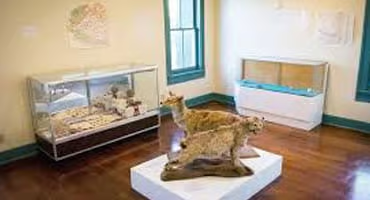
For a public, interpreted starting point, use the Antelope Valley Indian Museum State Historic Park. California State Parks describes the museum as displaying exhibits representing Native American cultures from the Antelope Valley, California coast, Great Basin, and Southwest. The park page says the Valley was a major prehistoric trade corridor linking those culture regions, and the official park history page says the museum has been public since 1932.
The park history page adds important context: the building is listed on the National Register of Historic Places, Piute Butte has been designated by the Native American Heritage Commission as a sacred landscape, and the museum exhibits thousands of objects. Because this is sensitive cultural history, do not speculate, disclose unpublicized sites, or treat artifacts as props. Use State Parks interpretation, follow posted rules, and respect closures.
Hours, fees, access, and partial closures can change. As of the State Parks page checked for this draft, the park page included current hours, entry fees, location, and restrictions, but readers should always review the official page before visiting.
Aqueduct, Drought, Mining, and the Desert Economy
The AV's historic landscape is also shaped by water and extractive industries. LA County Library says a decade-long drought beginning in 1894 badly damaged the regional economy and forced many settlers to abandon homesteads. It also says irrigation methods, electricity, and the 1913 completion of the Los Angeles Aqueduct helped revive local farming.
The OHP Western Hotel landmark record ties the aqueduct story directly to a visitable place: construction crews for the Los Angeles-Owens River Aqueduct were housed at the Western Hotel between 1905 and 1913. That makes the hotel more than an old building. It is a doorway into the history of water infrastructure, labor, and the relationship between the Antelope Valley, Owens Valley, and Los Angeles.
Lancaster's official history page also notes gold discoveries north of Lancaster in 1898 and borax in the mountains surrounding the Antelope Valley. Those topics can be fascinating, but many mine sites and old claims are unsafe, closed, privately owned, or environmentally sensitive. A public guide should point readers to museums, archives, and official interpretive sources rather than suggesting exploration of old mine workings.
A Responsible Historic AV Itinerary
Start in downtown Lancaster at Western Hotel Museum, but only after confirming current hours and access. Walk Lancaster Boulevard from public sidewalks and read it as a railroad-era corridor that has been remade for modern use. Add MOAH if the museum is open and current exhibitions fit the day.
Use lunch or coffee as a reset, then choose your second theme. If you want Palmdale history, go to Palmdale City Library resources, make an appointment for the Strasburg Collection if needed, and browse official historical photographs online before or after. If you want Native and desert-culture context, plan a separate visit to Antelope Valley Indian Museum State Historic Park and give it the time and respect it deserves.
Do not try to squeeze everything into one day. A three-part history route – Western Hotel, Palmdale library resources, Antelope Valley Indian Museum – crosses distance, subject matter, and access rules. It is better as a weekend or series of local outings.
Good to Know
- Confirm museum hours, tour availability, library appointment rules, fees, and closures directly with official sources.
- Do not enter private property, closed buildings, old mine workings, restricted aerospace areas, or unmarked desert sites.
- Treat Native heritage and sacred landscapes with care; rely on official museum, State Parks, tribal, or scholarly sources.
- Archival images usually require permission, credit, and rights review before publication.
- Historic claims about "oldest," "first," stage stations, building dates, and famous visitors should be sourced or avoided.
Make It a Day
- Morning: Western Hotel Museum during current public hours, plus a Lancaster Boulevard history walk from public sidewalks.
- Midday: MOAH, The BLVD, or a nearby lunch stop with current hours confirmed.
- Afternoon: Palmdale City Library local-history resources or a separate, planned visit to Antelope Valley Indian Museum State Historic Park.
More Antelope Valley Guides
- the Western Hotel Museum and early Lancaster
- the Antelope Valley Indian Museum guide
- the Aerospace Valley road trip
Sources and Further Reading
- LA County Library, Antelope Valley Local History
- City of Lancaster, History of Lancaster
- MOAH, Western Hotel Museum
- MOAH, History of Western Hotel Museum
- California Office of Historic Preservation, Western Hotel Landmark No. 658
- City of Palmdale, Discover Palmdale
- Palmdale City Library
- City of Palmdale, Strasburg Database
- City of Palmdale, Historical Photographs
- National Park Service, Butterfield Overland National Historic Trail
- California State Parks, Antelope Valley Indian Museum State Historic Park
- California State Parks, Antelope Valley Indian Museum Park History