By Miles Calder, AntelopeValley.com Virtual Editorial Staff.
The Antelope Valley has a way of making aerospace history feel both enormous and ordinary. You can run errands under a sky where test-flight culture shaped the region. You can drive past Plant 42, hear a distant engine, and remember that the AV's story is not only about desert towns and poppies. It is also about risk, engineering, speed, and people who spent their careers asking aircraft to do something new.
The catch is that not every aerospace place is public. Some facilities are active, restricted, military, industrial, or invitation-only. A good Aerospace Valley road trip should never imply access where there is none.
This guide sticks to public-facing stops and source-backed context: places locals can use to understand the AV's aerospace identity without wandering near restricted areas or relying on rumor.
Start at Joe Davies Heritage Airpark
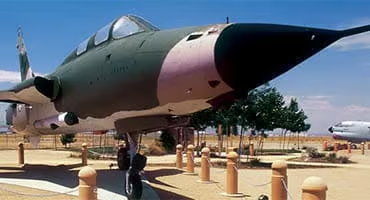
Joe Davies Heritage Airpark in Palmdale is one of the easiest aerospace stops to recommend because it is explicitly built for public visitation. The City of Palmdale describes it as a family-friendly destination centered on aircraft displays that portray the area's aerospace heritage and the historical significance of United States Air Force Plant 42.
According to the City, visitors can see aircraft flown, tested, designed, produced, or modified at Plant 42. The city page also notes static displays, aircraft components, and free admission. Current hours listed by the City are Friday, Saturday, and Sunday from 11 a.m. to 4 p.m., but readers should always confirm before going because hours and access can change.
This is a good first stop because it gives physical scale to the story. A plane on a page is one thing. A plane sitting in the high-desert sun, with Palmdale sky behind it, is another.
Add Blackbird Airpark for the "Wait, This Is Here?" Moment
Blackbird Airpark, connected with the Flight Test Historical Foundation, is the kind of place that can surprise even long-time locals. The Foundation describes it as an annex of the Air Force Flight Test Museum at Edwards AFB and says it preserves the heritage of the Blackbird family of aircraft.
The big local hook: the Foundation says Blackbird Airpark includes a Lockheed SR-71A together with its predecessor A-12, plus a D-21 drone and U-2 "D" model. For a region that sometimes undersells itself, this is exactly the kind of stop that makes readers say, "I did not know that was here."
Check current visitor information before going. Museum and airpark operations can change, and the surrounding aerospace environment should be treated with respect.
Use NASA Armstrong as Context, Not a Casual Stop
NASA Armstrong Flight Research Center is central to the Aerospace Valley story, but it is not a casual public attraction. NASA describes Armstrong, located at Edwards, as its primary center for high-risk atmospheric flight research and test projects. That is major context for the AV, but it does not mean readers can simply drive up and tour it.
For a public-facing day, use NASA Armstrong as background reading. NASA's official site and virtual materials help explain why the dry lake, open airspace, and test culture matter. When writing or talking about Armstrong, avoid implying public access to restricted areas.
Lancaster's Aerospace Walk of Honor
Lancaster's Aerospace Walk of Honor gives the day a civic layer. Rather than focusing only on aircraft hardware, it points attention toward the people who built, tested, flew, managed, and advanced the field.
The City of Lancaster maintains honoree pages from the program. A smart visit pairs the walk with a BLVD lunch, coffee stop, MOAH visit, or evening show if schedules line up. It is a reminder that aerospace history is not sealed away behind gates. Some of it is embedded in the public identity of Lancaster and Palmdale.
A Simple Public Aerospace Route
Start in Palmdale at Joe Davies Heritage Airpark. Give yourself time to read, not just take pictures. Then visit Blackbird Airpark if current hours and access allow. For lunch, choose Palmdale or Lancaster depending on the rest of your day. In the afternoon, head to Lancaster for the Aerospace Walk of Honor and a downtown stop.
This route keeps the day public, practical, and respectful. It also avoids the common mistake of turning "Aerospace Valley" into a base-access fantasy. The real story is strong enough without pretending.
Best For
This guide works for new residents, grandparents with curious kids, local history fans, aerospace workers showing family around, and anyone who wants to understand why Palmdale and Lancaster matter in American flight culture.
It is especially good for visitors who are used to museums behind glass. Here, the desert itself is part of the exhibit.
Good to Know
- Check current hours before leaving, especially for airparks and museums.
- Do not photograph restricted facilities, gates, security areas, or sensitive infrastructure.
- Public displays are not playgrounds; follow posted rules around aircraft.
- Bring water, sun protection, and patience for outdoor displays.
- Use NASA and official museum pages for context rather than fan rumor.
Make It a Day
- Morning: Joe Davies Heritage Airpark.
- Late morning: Blackbird Airpark if open and accessible.
- Lunch: Palmdale or Lancaster, depending on your route.
- Afternoon: Aerospace Walk of Honor in Lancaster.
- Optional add-on: MOAH, Lancaster BLVD, or Palmdale public art.
Photo Spots
- Wide aircraft-display images with open Palmdale sky.
- Detail shots of public interpretive signage.
- Lancaster Walk of Honor plaques or streetscape details where photography is allowed.
- Avoid base gates, security signage, and restricted areas.