By Miles Calder, AntelopeValley.com Virtual Editorial Staff.
An Aerospace Valley road trip is not about sneaking up to a fence line or pretending active test facilities are tourist attractions. The smarter version is better anyway: a public-facing day through Palmdale and Lancaster that lets you stand beside historic aircraft, connect the Antelope Valley to NASA flight research, read the names of test pilots downtown, and understand why this desert keeps showing up in the story of American aerospace.
The key phrase is public-facing. Much of the AV's aerospace work happens behind gates, on secure airfields, inside contractor facilities, or across restricted military land. Those places should be respected as working sites, not treated as photo stops. But the valley also has accessible places where locals can learn the story without guessing, trespassing, or overselling what visitors can see.
This route is built around those places: Joe Davies Heritage Airpark in Palmdale, Blackbird Airpark next door, NASA Armstrong Flight Research Center as a research context and virtual stop, and Lancaster's Aerospace Walk of Honor as a downtown history walk. It is a practical day for AV locals, new residents, aviation fans, families with older kids, and out-of-town guests who keep hearing "Aerospace Valley" and want to know what that actually means.
Stop 1: Joe Davies Heritage Airpark at Palmdale Plant 42
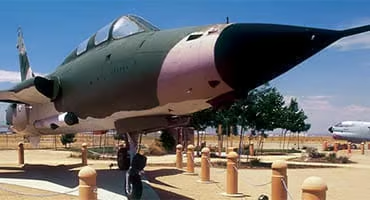
Start at Joe Davies Heritage Airpark, the most straightforward public stop for a first Aerospace Valley road trip. The City of Palmdale describes it as a family-friendly destination centered on aircraft displays that present the historical significance of United States Air Force Plant 42.
The official city page says visitors can see aircraft that were flown, tested, designed, produced, or modified at Plant 42. As of the researched page, the airpark includes 21 retired military aircraft on static display, plus a 1/8 scale model of the B-2 Spirit, an AGM-28 Hound Dog missile, a B-52, a C-46, and aircraft components. The city also states that admission to the park and its amenities is free.
That is a lot of aerospace history in one outdoor stop. It is also why this route starts here instead of with a secure facility. Joe Davies gives visitors a real physical encounter with the valley's aircraft heritage without asking them to speculate about what is happening behind nearby gates.
The official address is 2001 E Avenue P in Palmdale. The city lists public hours as Friday, Saturday, and Sunday, 11 a.m. to 4 p.m. Hours can change, and outdoor facilities can be affected by weather, events, maintenance, or staffing, so confirm current hours before you go. The city brochure also says guided tours with airpark staff or volunteers are available upon request by phone.
Plan to take your time. The airpark rewards slow looking: nose shapes, landing gear, intake designs, faded markings, aircraft scale, and the way desert light turns the displays into silhouettes. For families, it can be a good place to talk about the difference between production, test, research, and display. For adults who grew up seeing aircraft overhead, it can connect familiar sounds to names and missions.
Stop 2: Blackbird Airpark Next Door
From Joe Davies, continue to nearby Blackbird Airpark, operated as an annex of the Air Force Flight Test Museum at Edwards AFB. The Flight Test Historical Foundation lists Blackbird Airpark at 2503 E Avenue P in Palmdale and states that admission is free. The foundation lists public hours as Friday through Sunday, 11 a.m. to 4 p.m., but visitors should verify before going because museum hours are changing details.
Blackbird Airpark is the more specialized stop. The foundation says it was officially dedicated on September 27, 1991, and was established to preserve the heritage of the Blackbird family of military aircraft. It describes the display as including a Lockheed SR-71A with its predecessor A-12, the once ultra-secret D-21 drone, and a U-2 "D" model.
This is where the road trip gets quiet in a good way. The Blackbird aircraft are not subtle. They look like speed, secrecy, heat, altitude, and Cold War engineering turned into shapes. Even readers who are not aviation experts usually understand, standing there, that the Antelope Valley was not just near aerospace history. It helped hold the conditions that made that history possible: open land, test ranges, dry weather, long horizons, and a workforce built around advanced aircraft.
Do not rush this stop. Read signs. Compare the Blackbird shapes with the aircraft at Joe Davies. Notice how an outdoor airpark lets visitors understand scale in a way indoor photos rarely do. Also remember that these are museum displays, not climbing structures. Follow posted rules, keep children close, and do not cross barriers for a better photo.
Stop 3: NASA Armstrong as the Context Stop
NASA Armstrong Flight Research Center is essential to any Aerospace Valley road trip, but it is not a casual walk-in attraction. NASA identifies Armstrong as its primary center for high-risk atmospheric flight research and test projects. The center is located at Edwards, California, and NASA notes its access to remote land, year-round flying weather, and the Bell X-1 Supersonic Corridor.
That is the kind of sentence that explains the AV's aerospace identity in plain terms. The landscape is not incidental. NASA Armstrong's work depends on facilities, weather, airspace, engineering, flight operations, and research culture that have been built here over generations.
For visitors, the safest planning language is this: use NASA Armstrong as an official learning stop, not as a public-access promise. The center's public website, fact sheets, image galleries, aircraft pages, Quesst mission updates, and virtual tour are the right way to add NASA to the day unless NASA announces a specific public event or access opportunity.
NASA's Armstrong site lists current and recent research aircraft and describes the center's role in aeronautics, science, space projects, and technology development. The agency's aircraft page includes F/A-18 research jets, Gulfstream aircraft used for science and mission support, ER-2 high-altitude aircraft, and the X-59 quiet supersonic research aircraft tied to NASA's Quesst mission.
For a road trip, that means you can stand at the airparks in Palmdale, then pull up NASA's official Armstrong or Quesst pages over lunch or later at home and connect the displays to work still unfolding in the desert.
The X-59 Thread: A Current Aerospace Valley Story
If you want one modern thread to explain why Aerospace Valley is not just nostalgia, use NASA's X-59. NASA's Quesst mission features the one-of-a-kind X-59 aircraft, built to demonstrate technology for quiet supersonic flight without the loud sonic booms historically associated with faster-than-sound travel.
NASA's Quesst page lists the mission as active, with first flight in 2025 and a mission duration through 2029. NASA's April 17, 2026 Quesst update reported that the X-59 had reached its highest and fastest flights so far in April test flights, making progress toward supersonic flight. The same update says the aircraft's first flight took it over Palmdale and Edwards before landing at NASA Armstrong.
That is current, official, and local enough to matter. But it also needs cautious wording because test programs evolve. Do not write that visitors can see the X-59 on demand. Do not imply a public schedule for flight tests. Do not encourage people to stake out roads or facilities. The useful reader action is to follow NASA's official Quesst and Armstrong updates.
For local pride, the point is larger: the AV is still part of experimental flight, not merely a museum district for it.
Stop 4: Lancaster's Aerospace Walk of Honor
After the Palmdale airparks, head to Lancaster for the Aerospace Walk of Honor context. NASA describes the Walk of Honor as a series of sidewalk monuments with brass plaques summarizing the careers of military and civilian pilots who contributed to aviation development at nearby Edwards Air Force Base.
City of Lancaster pages for the program identify it as concluded, so this is not an annual induction event guide. Treat it as a downtown history walk. The value is in slowing down and reading names that otherwise blur into the phrase "test pilot." These were people involved in dangerous, technical work that pushed aircraft, data, and human judgment into new territory.
Because the Walk is in a downtown environment, pair it with whatever is currently open along The BLVD, the Museum of Art and History, a city event, or a meal stop. Do not invent a restaurant itinerary in the article unless those businesses are verified before publication. The safe copy is simple: check current hours and listings before building the Lancaster portion of the day.
This stop also gives the road trip a useful shift in scale. Joe Davies and Blackbird Airpark show aircraft. NASA Armstrong shows the research context. Lancaster's Walk of Honor brings the human names into the route.
What About Edwards Air Force Base and the Flight Test Museum?
This is the section that keeps the article honest.
The Air Force Flight Test Museum is important, but public access is not the same thing as interest. The Flight Test Historical Foundation's visit page currently states that the museum at Edwards AFB is open to those with current base access and closed to the general public, with a new Flight Test Museum anticipated to be open to all. Because that status can change, readers should check the official museum or foundation page before making plans.
For now, do not tell general readers to drive to Edwards expecting museum access. Do not imply that base gates, secure areas, or active facilities are attractions. If a future off-base museum opens with public hours, that should become a refresh item for this article.
The same caution applies to Plant 42 and contractor facilities in Palmdale. They are part of the aerospace story, but they are working installations. Stay on public roads, obey signs, avoid restricted areas, and do not stop in unsafe places for photos. The accessible story is already strong enough without pushing boundaries.
A Realistic One-Day Itinerary
The cleanest version of this trip is a Friday, Saturday, or Sunday when the Palmdale airparks list public hours. Start late morning at Joe Davies Heritage Airpark. Give yourself at least an hour if you like to read signs, take photos, or talk through the aircraft with kids.
Move next door to Blackbird Airpark. Spend another 45 minutes to an hour there, more if your group includes aviation people who will want to linger. Keep water in the car and plan for sun exposure; these are outdoor stops in the high desert.
Break for lunch in Palmdale or Lancaster, checking current hours for any restaurant or cafe. During lunch, pull up NASA's Armstrong virtual tour or Quesst page and connect what you just saw to current research. This is a good moment to explain that NASA Armstrong itself is not being presented as a walk-in visitor center for this itinerary.
In the afternoon, head to Lancaster Boulevard for the Aerospace Walk of Honor and a downtown stroll. If a museum, gallery, performance, or city event is part of the plan, verify hours and ticketing directly before including it in a final published itinerary.
End the day with a simple question: what did the desert make possible here? The answer is not only aircraft. It is weather, space, distance, testing, risk, manufacturing, engineering, and generations of workers whose names may never be on a plaque.
Who This Trip Works For
This route works well for AV locals who have driven past the aerospace landscape for years but never stopped to read it. It works for families with older kids who like machines, history, space, or military aircraft. It works for visiting relatives who need one strong "this is where we live" outing. It works for photographers who are content with public displays and respectful museum rules.
It may not work as well for very young children on hot days, visitors who need indoor museums only, or anyone expecting active facility tours. It is also not a great route during extreme heat, high winds, or poor air quality. Build the day around conditions, not just enthusiasm.
FAQ
Can the public visit NASA Armstrong? Do not assume walk-in public access. Use NASA's official public pages, virtual tour, fact sheets, mission updates, and any announced public events. Access rules can change and secure facilities should be respected.
Is Joe Davies Heritage Airpark free? The City of Palmdale states that admission to Joe Davies Heritage Airpark and use of its amenities is free. Confirm current hours and any event impacts before going.
Is Blackbird Airpark free? The Flight Test Historical Foundation lists admission as free and posts public hours for Friday through Sunday. Confirm current hours before making plans.
Can the general public visit the Air Force Flight Test Museum at Edwards? The foundation's current visit page states the Edwards museum is open to those with current base access and closed to the general public, with a new museum anticipated. Check the official page for updates.
Good to Know
- Plan the airpark portion for Friday, Saturday, or Sunday only after confirming current hours.
- Expect outdoor conditions: sun, wind, heat, and limited shade can shape the day.
- Do not treat secure aerospace facilities, base gates, or contractor sites as visitor attractions.
- Use NASA's official pages for current X-59, Armstrong, and research aircraft information.
Make It a Day
- Morning: Joe Davies Heritage Airpark and Blackbird Airpark in Palmdale.
- Midday: lunch in Palmdale or Lancaster, with current hours checked before publication.
- Afternoon: Lancaster Aerospace Walk of Honor and a downtown stop such as MOAH or The BLVD if current listings support it.
- At-home add-on: NASA Armstrong virtual tour or Quesst mission updates for deeper context.
More Antelope Valley Guides
- public aerospace stops in Palmdale and Lancaster
- the easy Palmdale family day
- historic Antelope Valley places to know
Sources and Further Reading
- City of Palmdale, Joe Davies Heritage Airpark
- City of Palmdale, Joe Davies Heritage Airpark brochure PDF
- Flight Test Historical Foundation, Visit the Museum and Blackbird Airpark
- NASA, Armstrong Flight Research Center
- NASA, Visit NASA's Armstrong Flight Research Center virtual tour
- NASA, Aircraft Flown at Armstrong
- NASA, Quesst mission
- NASA, Latest NASA X-59 Flights Go Higher and Faster
- NASA, Aerospace Walk of Honor context
- NASA, Images and Media Usage Guidelines
- City of Lancaster, Aerospace Walk of Honor honoree pages